
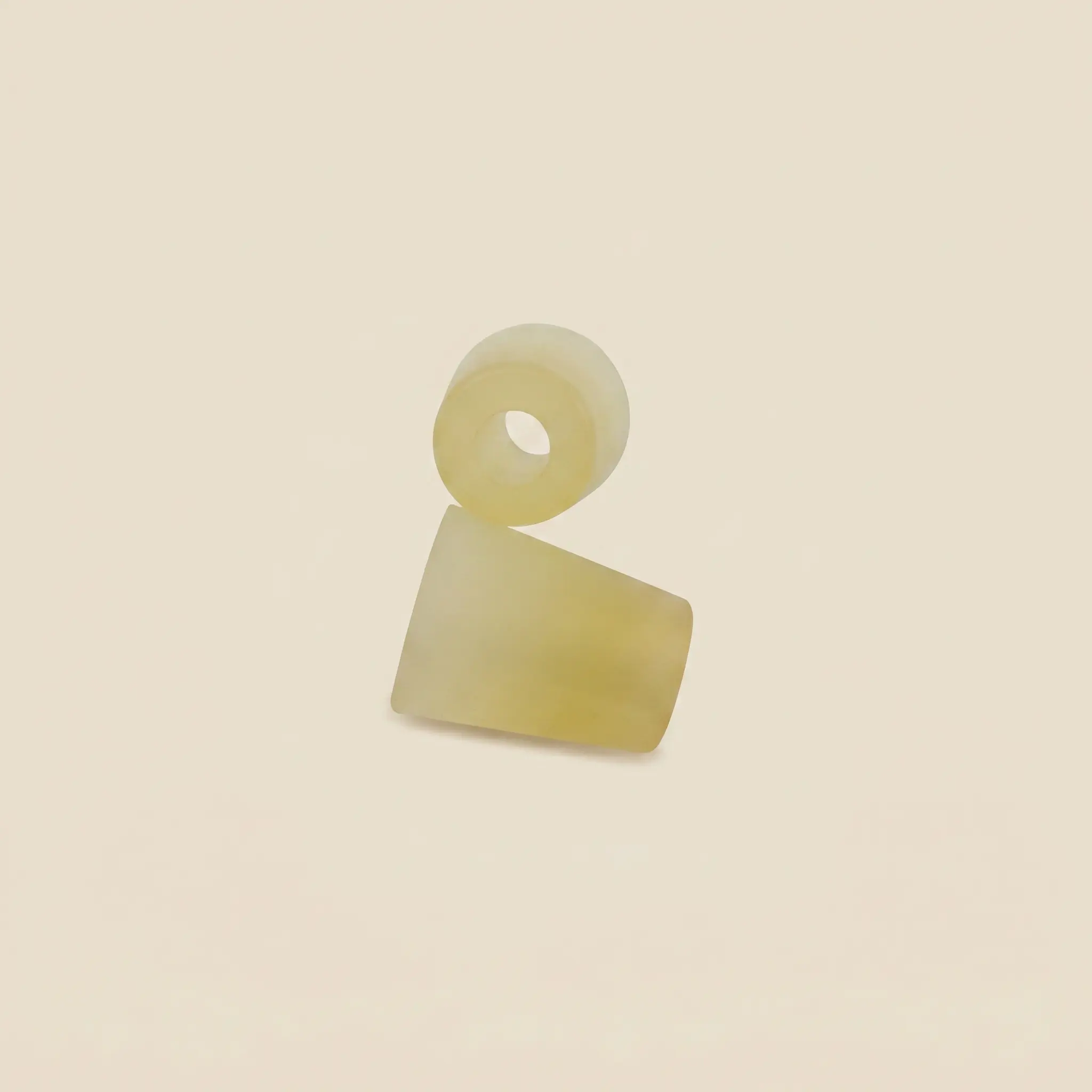
Perforated silicone stopper is a small but very useful accessory when openings are to be closed cleanly while at the same time guiding a thermometer, a tube or a hose through them. In simple laboratory set-ups, in work with reactors or when preparing measurements, a suitable stopper helps to hold components in place in a controlled way. It does not replace the planning of the overall set-up, but it does turn an open vessel mouth into a more usable feed-through.
Perforated silicone stopper for clean feed-throughs
A perforated silicone stopper is used wherever an opening should not remain fully unobstructed but a component still needs to be passed through it. This may be a thermometer reaching into a liquid, a glass tube, a connector or a thin hose. The bore guides the component and the stopper sits in the opening of the matching vessel or set-up. This makes the work more orderly, components are less likely to slip and handling becomes more controlled.
This is particularly sensible in applications where several accessories work together. A vessel, a measuring instrument and a feed-through have to match one another. The silicone stopper is the unobtrusive connecting part that turns individual pieces into a more practical set-up. It is therefore of interest not only for classical laboratory work, but also for users who wish to work cleanly with vinegar, fermentation, measurement or small quantities of liquid.
Concrete benefits in everyday use
- Guided feed-through: thermometers, tubes or hoses are not loosely inserted into the opening, but guided through the stopper in a controlled way.
- Tidy set-up: the work area remains clearer because components have a fixed position.
- Versatile accessory: suitable for simple measuring set-ups, reactor work and practical laboratory applications.
- Gentle handling: silicone is elastic, so the stopper is easier to insert and remove than rigid stoppers.
- Combines well: particularly helpful together with thermometers, glass vessels, reactor components and dispensing accessories.
Use with a thermometer, tube or hose
Before use, it should be checked whether the stopper matches the opening and whether the bore matches the component being passed through. A component that sits too loosely can slip, while one that fits too tightly can be difficult to insert or place strain on delicate parts. With a thermometer, it is important that the tip is positioned at the desired measuring point and does not touch the bottom or the wall of the vessel. The thermometer can be held in position more easily with the stopper, but correct placement still remains the user’s responsibility.
With hoses and tubes, work should likewise proceed without force. If a part slides through the bore with difficulty, it often helps to release the set-up again, align it straight and insert the part slowly. Sharp edges, tilted glass tubes or excessive tensile load should be avoided. This protects the stopper, the component being passed through and the overall set-up.
Cleaning and storage
After use, the silicone stopper should be cleaned promptly, particularly if it has come into contact with acidic, aromatic or staining liquids. In many cases, thorough rinsing with water followed by drying is sufficient. For heavier soiling, a mild cleaning may be sensible. Aggressive solvents or untested cleaning agents should not simply be applied, because material compatibility depends on the specific medium.
A dry, clean place is sensible for storage. The stopper should not be permanently compressed or stored together with sharp-edged objects. Direct contamination by dust, oils or strong odours should also be avoided so that it can be reused cleanly on the next occasion. Anyone who uses several stoppers or accessories should store them separately and in a traceable way so that size and intended purpose are not confused.
Avoiding mistakes
Common mistakes do not arise from the stopper itself, but from unsuitable combinations. If too large a tube is forced through too small a bore, the set-up can be loaded unnecessarily. If the stopper does not fit the opening properly, the entire set-up will feel unstable. A poorly positioned thermometer also provides little practical insight in practice, even if the instrument itself is sound. The set-up should therefore be checked dry before actual use.
For applications involving pressure, reduced pressure, hot media or reactive substances, the entire set-up must be designed appropriately by competent persons. The silicone stopper is an accessory for a feed-through and not an automatic safety component. Always check whether the vessel, medium, temperature, components and cleaning method match the planned application.
Matching products in the shop
The perforated silicone stopper pairs particularly well with products in which components are guided or openings are usefully supplemented. These include the thermometer for temperature monitoring, the beaker for simple work with liquids and the measuring cylinder when samples are prepared or measuring instruments are used. In the area of vinegar production, it can be practical in set-ups around the Schmickl Vinegar Reactor, while the pump for the vinegar reactor and the air filter for the vinegar reactor are further typical spare and accessory parts for reactor operation.
For clean work with liquids, the wash bottle, 500 ml, the glass Pasteur pipette or the plastic Pasteur pipette can also be helpful. Depending on the task, the stopper can thus be integrated into a simple, clear workflow: prepare, measure, dispense, clean and store tidily again.
Further information
General information on the material can be found in the neutral Wikipedia article on silicones. For the specific use of this product, what matters is that size, bore and application are matched. When that is the case, the perforated silicone stopper is a practical accessory for clean feed-throughs and recurring work with measuring or connecting parts.
Technical details
| Weight | 0,007 kg |
|---|---|
| Dimensions | 2 × 1,5 × 1,5 cm |
Reviews
There are no reviews yet.