
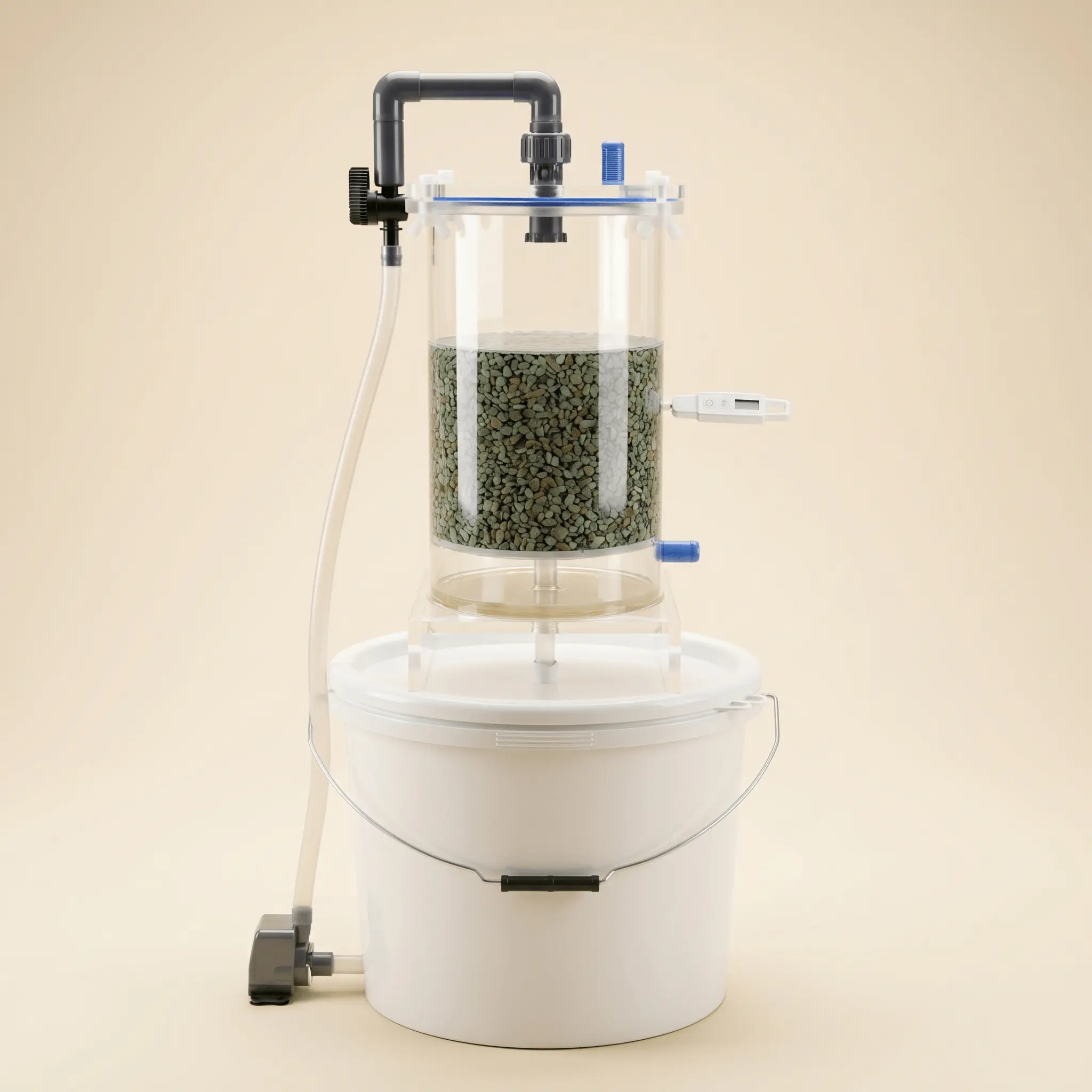
The Schmickl Vinegar Reactor is a system we developed for producing high-quality vinegars using the fixed-bed acetic fermentation process. The acetic acid bacteria colonise the filling bodies in the reactor and are sprayed at defined intervals with the fermentation medium. As a result, the acetic fermentation proceeds in a markedly more controlled, faster and cleaner manner than with the simple surface process.
The reactor is particularly interesting for anyone who not only wants to produce vinegar but also to shape its flavour deliberately. In addition to flavour-neutral filling bodies such as Zeolite Spezial, herbs, spices, dried fruit, wood chips or other aroma-giving materials can also be used. This results in full-bodied, characterful fixed-bed acetic fermentation vinegars that differ clearly from simple infused vinegar.
The reactor is suitable for quantities of approximately 5 to 15 litres with the supplied oval bucket. With other connected containers, larger quantities of up to a maximum of 100 litres are also possible. The acetic fermentation takes approximately 4 to 14 days, depending on the fill quantity.
View of the Vinegar Reactor

How the Vinegar Reactor works
The Vinegar Reactor works according to the fixed-bed process. Inside the reactor there are filling bodies on which the acetic acid bacteria settle. The fermentation medium is distributed regularly over these filling bodies via a spray head and then drains back down again.
To start, the reactor is operated for several days with fermenting vinegar so that the filling bodies are reliably colonised with acetic acid bacteria. After that, the fermentation medium can be replaced with alcohol or alcohol-containing source material. Once this has been converted to vinegar, more alcohol can be added or the medium can be exchanged.

Zeolites as a flavour-neutral support structure

for the controlled return flow of the medium

for even distribution inside the reactor
The main advantages
- Faster acetic fermentation: approximately 4 to 14 days, depending on the fill quantity.
- Fermentation often starts after a short time: frequently within approximately 48 hours.
- High quality: clear, clean and aromatic vinegars.
- Controlled process: simple monitoring via the reactor temperature.
- Less evaporation loss: alcohol losses remain very low.
- No mother of vinegar: no disruptive mother of vinegar forms as with the surface process.
- No vinegar eels: clean operation without the typical problems of simple processes.
- Flexible flavour design: herbs, spices, dried fruit, wood chips or zeolite possible.
- Scalable: with the oval bucket for 5 to 15 litres, with another container up to a maximum of 100 litres.
- Also suitable for special vinegars: e.g. fruit vinegar, beer vinegar, herb vinegar or spice vinegar.
Aroma directly during acetic fermentation
A particular strength of the Vinegar Reactor is the option to use aroma-giving filling bodies directly inside the reactor. In addition to flavour-neutral zeolite, herbs, spices, dried fruit, wood chips or dried fruits can be used, for example.
This is not a simple infused vinegar, where finished vinegar only subsequently extracts flavour from ingredients. With fixed-bed acetic fermentation vinegar, the fermentation process takes place directly on or between the aromatic materials. As a result, particularly full-bodied, smooth and intense vinegars can develop.
Depending on the desired flavour intensity, approximately 10 to 90 % of the reactor volume can be filled with aroma-giving substances. Beech wood chips, optionally smoked, can also be used to give the vinegar a particular character.

Reactor, accessories, zeolite, pump and control

Spraying and return flow inside the reactor
Difference from the surface process
In the classic surface process, acetic fermentation takes place mainly at the surface of the liquid. This process is simple but slow and more prone to disruption. The Vinegar Reactor, by contrast, works with colonised filling bodies and regular spraying of the fermentation medium. As a result, a considerably larger active surface is available to the acetic acid bacteria.
This leads to a markedly higher conversion performance. The daily decrease in alcohol content, or rather the increase in acetic acid, is considerably greater than with the surface process. At the same time, the process remains cleaner, easier to control and easier to continue.
Fill volume and application range
- With supplied oval bucket: approx. 5 to 15 litres
- With another connected container: up to a maximum of 100 litres
- Duration of the acetic fermentation: approx. 4 to 14 days, depending on the fill quantity
- Dimensions of the unit: approx. 40 cm width, 30 cm depth, 80 cm height
The reactor can be operated over an extended period. The complete exchange of the fermentation medium is also possible without fundamentally interrupting operation. As a result, the system is suitable not only for individual batches but also for continuous trials and smaller series.
Scope of delivery
- Reactor made of Plexiglas for 5 litres of filling bodies
- 2 base plates
- Outlet nozzle
- Conically shaped base plate for complete vinegar drainage
- Aeration nozzle
- 4 holders for perforated plate
- Head plate with sealing ring
- Reactor lid made of Plexiglas with filler neck and O-ring
- 4 hexagon screws with wing nuts
- 3 air-permeable screw caps
- U-tube with knurled nut, tap and hose nozzle
- 2 silicone hoses
- Perforated plate fine
- Perforated plate coarse
- Digital probe thermometer
- Clamp fitting for thermometer
- Spray head, four-part
- Clamp fitting for reactor outlet nozzle
- Delivery pump 220 V
- Time switch
- 5-litre bucket filled with Zeolite Spezial
- 18-litre oval bucket with lid
- Detailed operating instructions
Matching additions
For a clean monitoring of the fermentation process, suitable measurement equipment is sensible. With the Acetic Acid Analysis Set, the acid content can be determined precisely. As complementary tools, the Vinegar Measuring Set and the Vinegar Hydrometer can also be helpful.
Technical details
| Weight | 10,846 kg |
|---|---|
| Dimensions | 48,5 × 24,5 × 130 cm |
Reviews
There are no reviews yet.