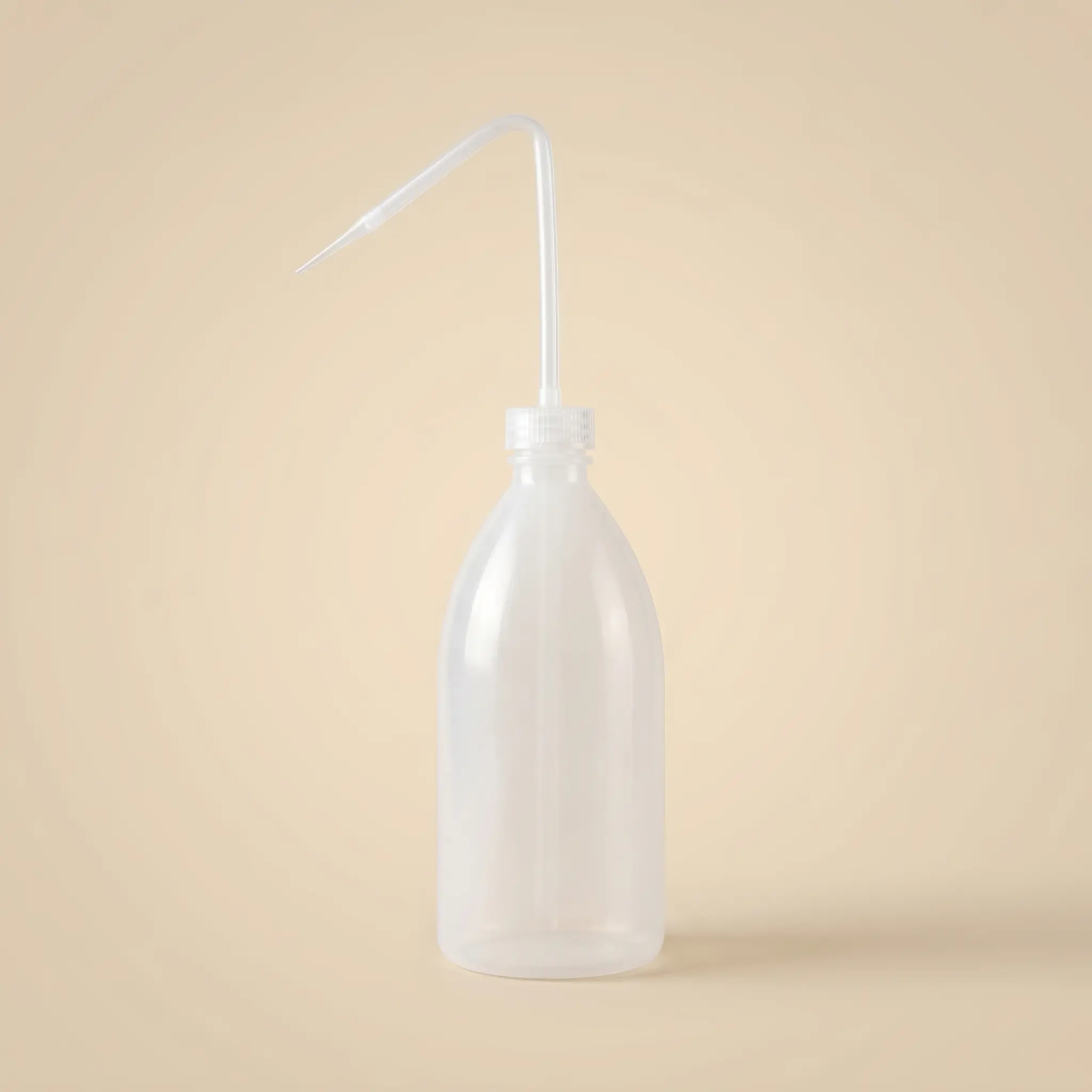
Wash bottle 500 ml is a practical accessory for the targeted dispensing, rinsing and after-rinsing of liquids. It is used wherever a liquid is not simply to be poured out, but delivered to a specific spot in a controlled way. For analysis work, for cleaning small vessels or for preparing samples, a handy wash bottle saves time and makes the workflow significantly tidier.
Wash bottle 500 ml for controlled rinsing and dispensing
The wash bottle is particularly helpful when water or a suitable working liquid needs to be applied in small quantities to glass walls, filters, pipettes or measuring vessels. Instead of pouring a vessel out in a rough way, the liquid jet can be directed more precisely. This is useful when rinsing out a beaker, after-rinsing a measuring cylinder or rinsing small residues from a filter or a vessel wall.
The 500 ml volume is a good compromise for many workshop, laboratory and hobby applications. The bottle holds enough liquid for several working steps while remaining easy to handle. For repetitive tasks in particular, this is more convenient than constantly refilling a small vessel or working with an open bottle.
Typical areas of use
- After-rinsing: residues from beakers, measuring cylinders or small vessels can be rinsed to the correct location in a targeted way.
- Cleaning: the bottle helps with the pre-cleaning of accessories before they are thoroughly cleaned and dried.
- Sample preparation: liquid can be added slowly without unnecessarily spilling onto the work area.
- Filtering work: when working with fluted filter paper, careful after-rinsing is possible without applying too much liquid at once.
- Analysis accessories: pipettes, beakers and measuring vessels can be handled more conveniently between working steps.
Use in analysis and laboratory practice
In simple analysis work, clean rinsing is often more important than it might first appear. When a sample is transferred to another vessel, small quantities remain on the glass walls or on the pipette tip. With the wash bottle, such residues can be after-rinsed in a targeted way. This is particularly sensible when working with defined sample quantities or when reaction vessels are to be transferred as completely as possible.
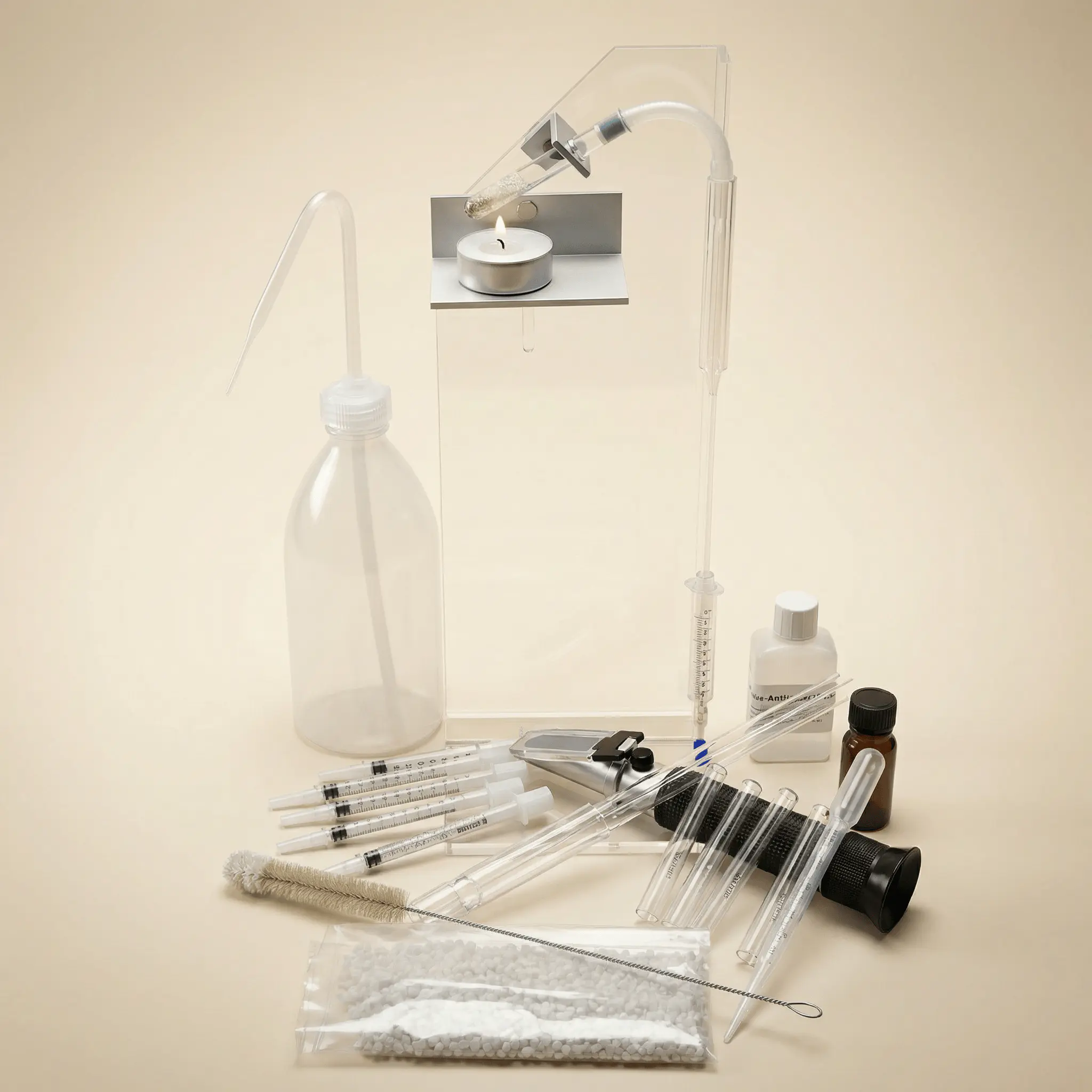
In the context of the Acetic Acid Analysis Set or the Alcohol Analysis Set, a wash bottle can help to handle vessels, pipettes and work surfaces in a tidy manner. It does not replace accurate measuring equipment such as a volumetric pipette, but makes clean handling around the actual measurement easier. When working with sodium hydroxide solution 1N, careful rinsing and separated working are also important. Which liquid is used in the wash bottle always depends on the task and on material compatibility.
Filling and using correctly
Before filling, the bottle should be clean and matched to the intended liquid. A wash bottle is frequently used with water or demineralised water. If other liquids are used, it should first be checked whether the bottle, closure and spray tube are suitable for them. Particular caution is required with solvents and strongly acidic or strongly alkaline liquids. Without confirmed suitability, the bottle should not be repurposed for other uses.
When working, a steady pressure is sensible. Pressing too hard can cause splashes, while too little pressure makes rinsing imprecise. Hold the spray tip close enough to the desired location without touching other parts. This keeps the liquid stream controlled and the bottle clean. After use the tip should not be laid down on dirty surfaces, so that no residues enter the bottle.
Cleaning, labelling and storage
A wash bottle should be clearly labelled if it is not used exclusively with water. This avoids confusion and makes workflows safer. After use a suitable cleaning is recommended. For water, rinsing out and drying is usually sufficient; for other liquids the cleaning must match the substance used. Residues in the spray tip can alter the jet or contaminate the next application.
Store the bottle upright, clean and with the closure shut. Direct heat, strong sunlight and unsuitable chemicals in the surroundings should be avoided. If the bottle is not used for an extended period, it is sensible to store it empty and dry. This keeps it clean and free of odours for the next use.
Matching products in the shop
The 500 ml wash bottle complements many simple laboratory and analysis products. It pairs well with the measuring cylinder and beaker when vessels are rinsed out or samples are prepared. For small quantities of liquid, the glass Pasteur pipette and the plastic Pasteur pipette are practical additions. For filtrations, the fluted filter papers are relevant; for titrations and vinegar analyses in particular, the Acetic Acid Analysis Set and sodium hydroxide solution 1N.
In the context of the Schmickl Vinegar Reactor, a wash bottle is also useful when accessories are cleaned, small quantities are after-rinsed or work areas are kept tidy. It is not a measuring instrument, but a very practical aid that makes many working steps easier and tidier.
Further information
A neutral introduction to the device can be found in the Wikipedia article on the wash bottle. For selection in the shop, what matters above all is which liquid is used, how often rinsing will be required and whether the 500 ml volume suits your own workflow.
Technical details
| Weight | 0,086 kg |
|---|---|
| Dimensions | 28 × 7,5 × 7,5 cm |
Reviews
There are no reviews yet.