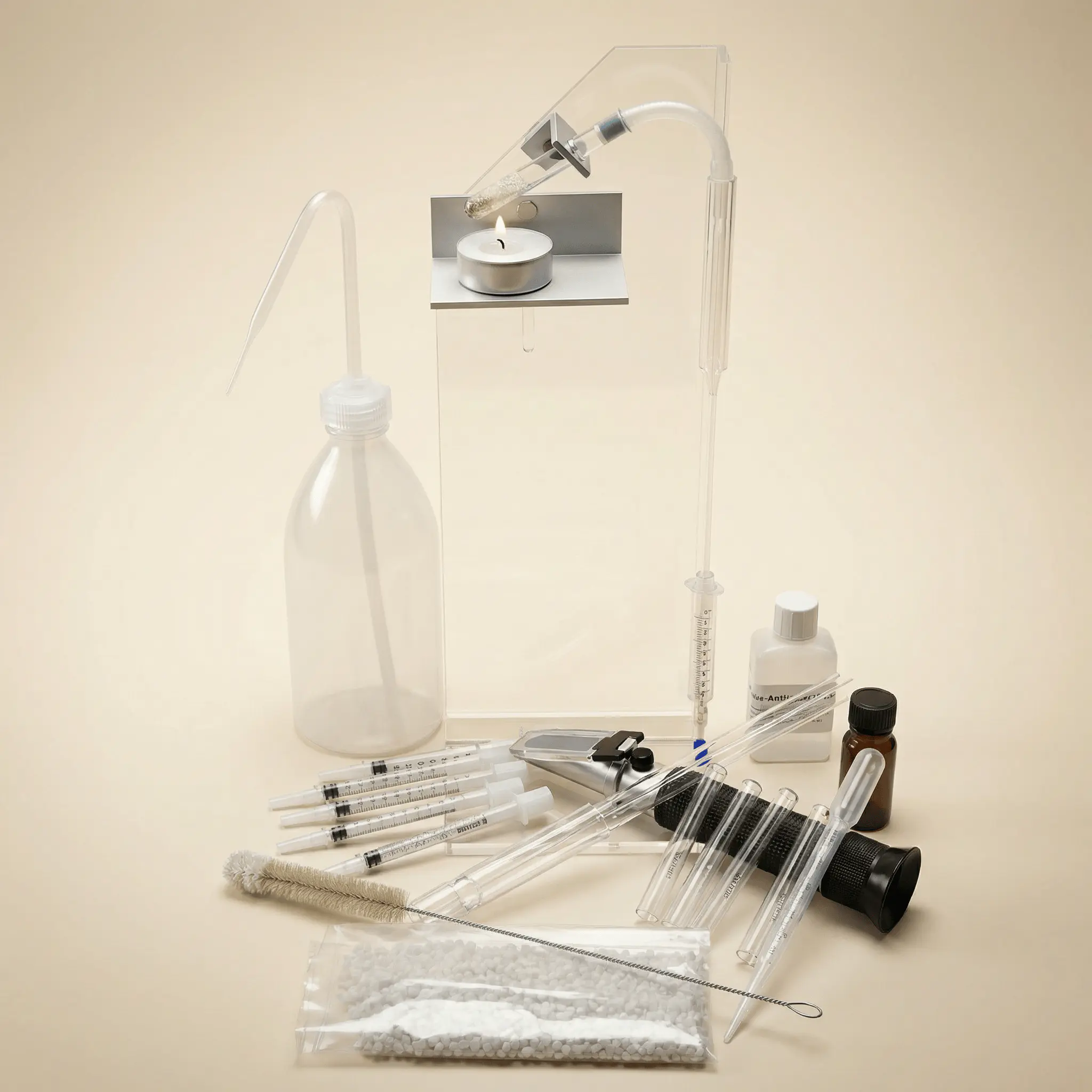
The Schmickl Alcohol Analysis Set serves for the precise determination of the alcohol content in vinegar, mash, liqueur, beer, wine and other alcoholic liquids. It is particularly sensible when simple measuring instruments do not provide reliable values, because sugar, extract substances, original wort or acids distort the measurement result.
In this method, the sample is first distilled on a semi-micro scale. This separates the alcohol from interfering accompanying substances. Only then is the distillate measured with the included alcohol refractometer. This makes a considerably more precise alcohol determination possible than with simple measuring instruments applied directly to the sample.
Why simple alcohol measuring instruments often provide incorrect values
An alcoholmeter, a vinometer or a refractometer can work well with pure alcohol-water mixtures. With vinegar, mash, liqueur, beer or wine, however, the sample is considerably more complex. Sugar, extract substances and, in the case of vinegar, additionally acetic acid alter the physical properties of the liquid. The displayed values can therefore deviate strongly from the actual alcohol content.
The Alcohol Analysis Set circumvents this problem by means of an upstream distillation. The alcohol is separated from the sample and then measured in the distillate. It is precisely this step that makes the difference between a rough estimate and a robust analysis.
Only 0.5 ml sample quantity
A major benefit of the set is the very small sample quantity. Only 0.5 ml of sample is required for the analysis. This is particularly practical with small fermentation batches, trial batches or valuable samples for which as little material as possible should be consumed.
Compared with classical distillation devices that often require considerably larger sample quantities, this apparatus operates on a semi-micro scale. It is therefore particularly suitable for small batches and precise individual measurements.
How the alcohol determination works
- Determine the acid content: with vinegar, 10 ml of sample is first titrated with sodium hydroxide solution and phenolphthalein so that the sample is neutralised. For this you require the Acetic Acid Analysis Set. With mash, liqueur, beer, wine and other acid-free alcoholic liquids, this step is omitted.
- Distillation: 0.5 ml of the neutralised or acid-free sample is distilled.
- Measure the alcohol: the alcohol content of the distillate is determined using the included alcohol refractometer.
The measurement results can then be evaluated using the online calculator on our website.
Accuracy and time required
- Accuracy: ± 0.1 %vol alcohol
- Time required without titration: approx. 8 to 10 minutes
- Time required with titration: approx. 15 minutes
- Sample quantity: only 0.5 ml
Scope of delivery
- stand made of Plexiglas
- aluminium brackets, large and small
- screws with wing nuts
- tea light
- test tubes
- boiling chips, type B
- anti-foam agent
- silicone hose with reinforcement piece
- glass Pasteur pipettes
- syringes with needle
- sealing cord
- wash bottle
- hand refractometer with automatic temperature compensation, 0 to 80 %vol, for ethanol
- accessories for the refractometer: storage box, screwdriver, plastic pipette, small bottle of distilled water, cleaning cloth and user manual
- test tube cleaning brush
- small amber glass bottle with screw cap
- plastic Pasteur pipette
- detailed user manual
Important note on the refractometer
A refractometer measures how strongly light is refracted in a liquid. This value is called the refractive index. It changes depending on which substances are dissolved in the liquid. There are therefore different refractometers for different applications. A sugar refractometer, for example, is used to measure the sugar content in grapes, juice or must. However, there are also special refractometers for measuring alcohol.
What matters is that sugar and alcohol both influence the refractive index. So when sugar, alcohol, water and possibly acetic acid are present simultaneously in a sample, a refractometer cannot reliably determine the alcohol content directly. The various ingredients distort the measurement result. For vinegar, mash, liqueur, beer or wine, a distillation before the measurement is therefore necessary. This separates the alcohol from the interfering accompanying substances. Only the pure distillate can sensibly be measured with an alcohol refractometer.
Caution: many sugar refractometers additionally carry a scale labelled „%vol alcohol“. These devices are nevertheless not true alcohol measuring instruments. This scale only indicates roughly how much alcohol could be produced after the fermentation of a sugar solution. A true alcohol refractometer has no sugar scale and is designed for the measurement of alcohol in a distillate.
Technical details
| Weight | 1,054 kg |
|---|---|
| Dimensions | 42,5 × 30 × 25 cm |
Reviews
There are no reviews yet.