
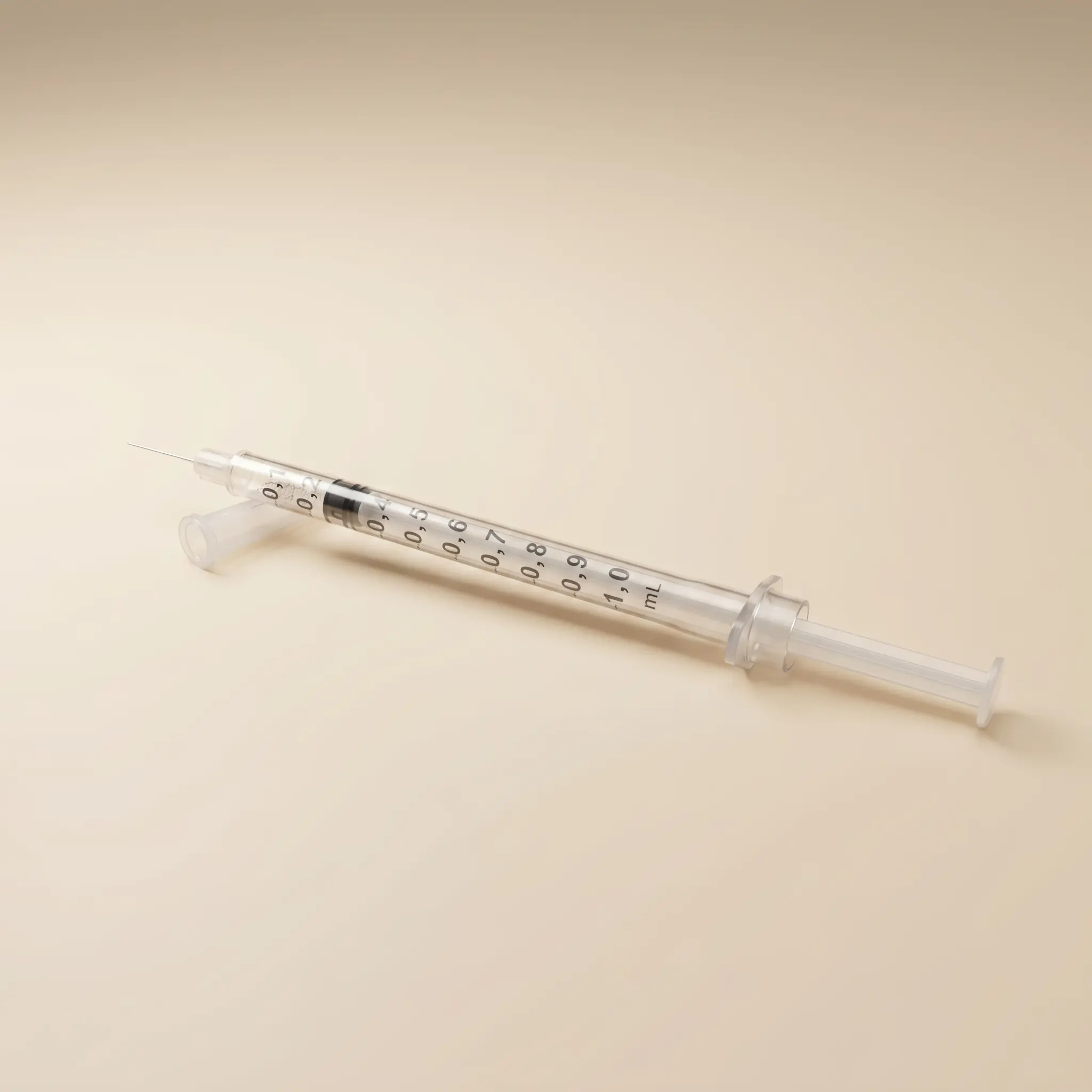
Syringe with needle 1 ml is a fine dispensing tool for drawing up, transferring and precisely adding small quantities of liquid. It is particularly useful when drops or very small volumes are to be handled in a more controlled way than by direct pouring. In the shop context, the focus is on use in analysis, laboratory and working procedures; medical instructions for use are not provided here.
Syringe with needle 1 ml for controlled dispensing
With small quantities of liquid, handling often determines how clean the work will be. A 1 ml syringe allows for considerably finer dispensing than a larger vessel. The needle helps to take up liquid precisely or to deliver it to a specific spot. This is useful when samples are prepared, reagents are added drop by drop or small quantities are to be transferred into a test tube 4 ml.
However, the syringe with needle does not replace a calibrated analytical instrument. When precisely defined measuring volumes are required, depending on the task a measuring cylinder, a volumetric pipette or suitable analysis accessories are the better choice. For practical dispensing tasks, controlled drawing up and small transfers, the 1 ml syringe is by contrast very handy.
Where the syringe is helpful in everyday laboratory work
The syringe with needle is well suited to work in which small quantities have to be brought into a vessel cleanly. With the Acetic Acid Analysis Set or the Alcohol Analysis Set, small quantities of liquid can be involved that should not be dispensed using a large beaker. The syringe is also a practical aid when preparing samples, topping up dispensed amounts or transferring liquid from small vessels.
Compared with a glass Pasteur pipette or a plastic Pasteur pipette, the syringe is particularly pleasant when more control over drawing up and dispensing is desired. Pipettes are very practical for quick dropping and decanting; the syringe, by contrast, offers different handling and can dispense small quantities in a targeted way. Which solution fits better depends on the working step.
Benefits at a glance
- 1 ml volume for small dispensing and transfer tasks
- needle for the precise uptake and delivery of small quantities of liquid
- practical for samples, analysis preparation and fine adjustments
- useful addition to test tubes, beakers, pipettes and measuring cylinders
- helps to avoid spillage and uncontrolled pouring
- well suited when several small working steps are to be carried out calmly one after another
Drawing up and dispensing cleanly
Before use, the liquid should be ready in a suitable vessel, for example in a small beaker or test tube. The needle should not be pressed unnecessarily against hard vessel bottoms. Drawing up slowly reduces air bubbles and makes the quantity more easily controllable. When dispensing, a calm approach is likewise sensible: small quantities are easier to dispense step by step than with a single quick push.
If different liquids are used in succession, the same unchecked syringe should not be moved between all the media. Residues can falsify the next result or carry over odours, colours and reaction remnants. Depending on the application, thorough rinsing, separated use or replacement of the tool is sensible. Specific material compatibility with particular chemicals should not be assumed without confirmation if no manufacturer information is available.
Cleaning, storage and handling of the needle
After use, the syringe should be cleaned as promptly as possible or set aside in accordance with the application. Dried-on residues can make the plunger stiff or block the needle. Care is important during cleaning, because the needle is sharp. It should not be left lying around loose, nor stored unprotected in drawers or among other accessories. Damaged or blocked needles should not be forced into further use.
A clear allocation is helpful at the workstation. Syringes, pipettes, test tubes and measuring accessories should be set down in such a way that clean and used items are not confused. Particularly in small analysis work, mistakes often arise not from complicated technique, but from residues, mix-ups or hasty dispensing.
Matching additions and context
The syringe with needle pairs well with the beaker for holding small quantities of liquid, the test tube 4 ml as a sample vessel and the measuring cylinder when volumes are to be measured. General information on the syringe can be found in a neutral form on Wikipedia. For specific selection in the shop, what matters is that this 1 ml syringe is a fine aid for controlled dispensing. It is particularly useful when drops, small samples and short transfers are to be carried out more cleanly than by free pouring.
Technical details
| Weight | 0,007 kg |
|---|---|
| Dimensions | 12 × 1 × 1 cm |
Reviews
There are no reviews yet.