
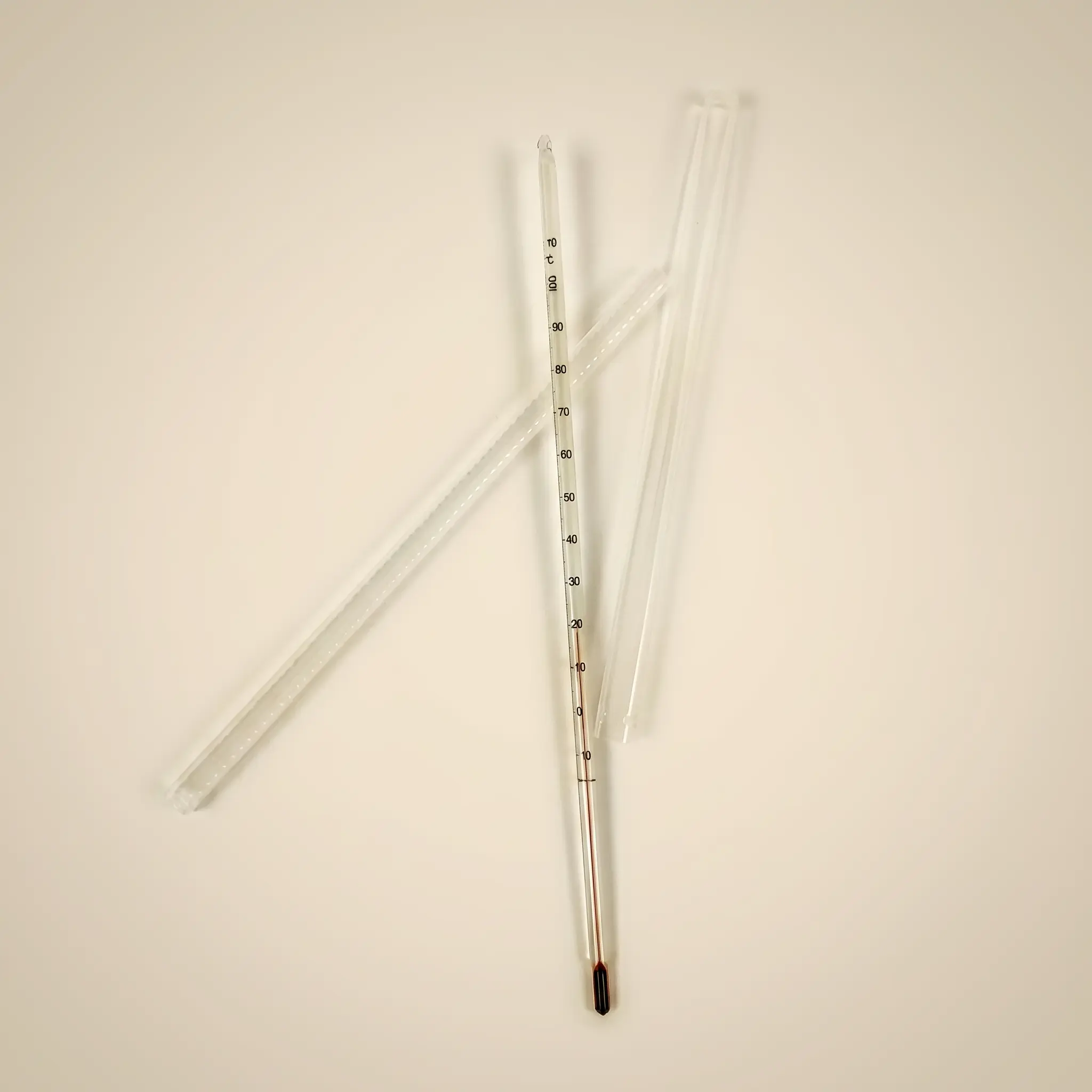
Thermometers are fundamental measuring instruments when temperatures are to be deliberately observed rather than merely estimated. In fermentation, distillation, analysis and simple laboratory work, temperature is often an important process indicator. This thermometer is therefore a practical accessory for users who wish to follow procedures in a more controlled way and record measured values in a comprehensible manner.
Thermometer for temperature control in the laboratory and in practice
A thermometer helps to make temperature changes visible. This is particularly useful when liquids are heated, cooled or observed over a longer period. In vinegar and alcohol practice this is not about mere curiosity, but about better orientation within the process. Anyone who knows the temperature range being worked in can plan procedures more calmly, recognise deviations more quickly and compare repeatable working steps more reliably.
The thermometer should be used in a way that suits the task. It does not replace complete process control or a safety assessment, but it provides important information. Particularly when working with glass, liquids and small samples, simple temperature monitoring is often more sensible than pure estimation. It is important to choose the measuring point deliberately and to consider the reading in the context of the set-up.
What a thermometer is used for
- Observing temperature: liquids, batches or working environments can be assessed more reliably.
- Comparing processes: repeated tasks become more traceable when temperature values are recorded.
- Accompanying fermentation: for vinegar or alcohol batches, monitoring temperature can be an important part of process management.
- Preparing distillation: with suitable set-ups, the temperature reading helps to follow the process more deliberately.
- Supporting analysis work: measurements and sample preparation become clearer when the temperature is not left unknown.
Practical use without unnecessary claims
When in use, the thermometer should be positioned so that the measuring zone actually covers the desired location. The tip should not unthinkingly rest on the bottom of the vessel or directly against a wall when the temperature of the liquid is to be observed. A drilled silicone stopper can help to guide the thermometer through an opening and hold it more steadily. Even so, the overall set-up must suit the task.
When reading the thermometer, a calm look at the scale or display is important. Where possible, read at eye level and note values with context, such as the time, the batch, the vessel and the working step. This makes temperature readings meaningfully interpretable later on. Without such context, an individual value can quickly be misunderstood. No accuracy specifications are claimed here, because for that the specific technical specification of the particular thermometer is decisive.
Use with vinegar, alcohol and analysis
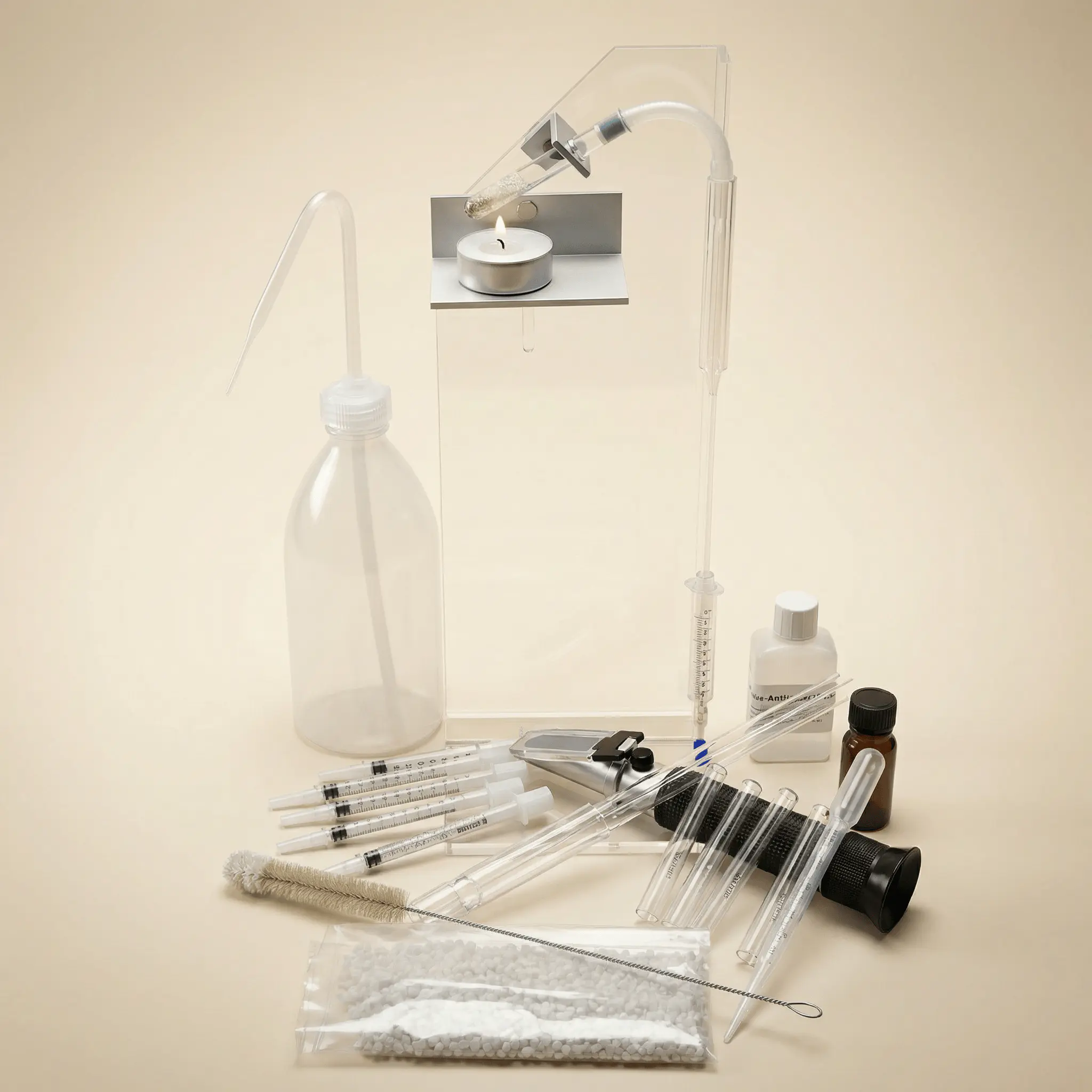
In conjunction with the Schmickl Vinegar Reactor, monitoring temperature can help to classify reactor operation more reliably. Acetic acid bacteria and fermentation processes respond to their environment, so it is sensible not to leave temperature values entirely to chance. The thermometer is, however, not responsible for the actual acetic acid content; for that, a suitable analysis such as the Acetic Acid Analysis Set is needed. When alcohol contents in complex samples are to be assessed, the Alcohol Analysis Set is the more appropriate tool.
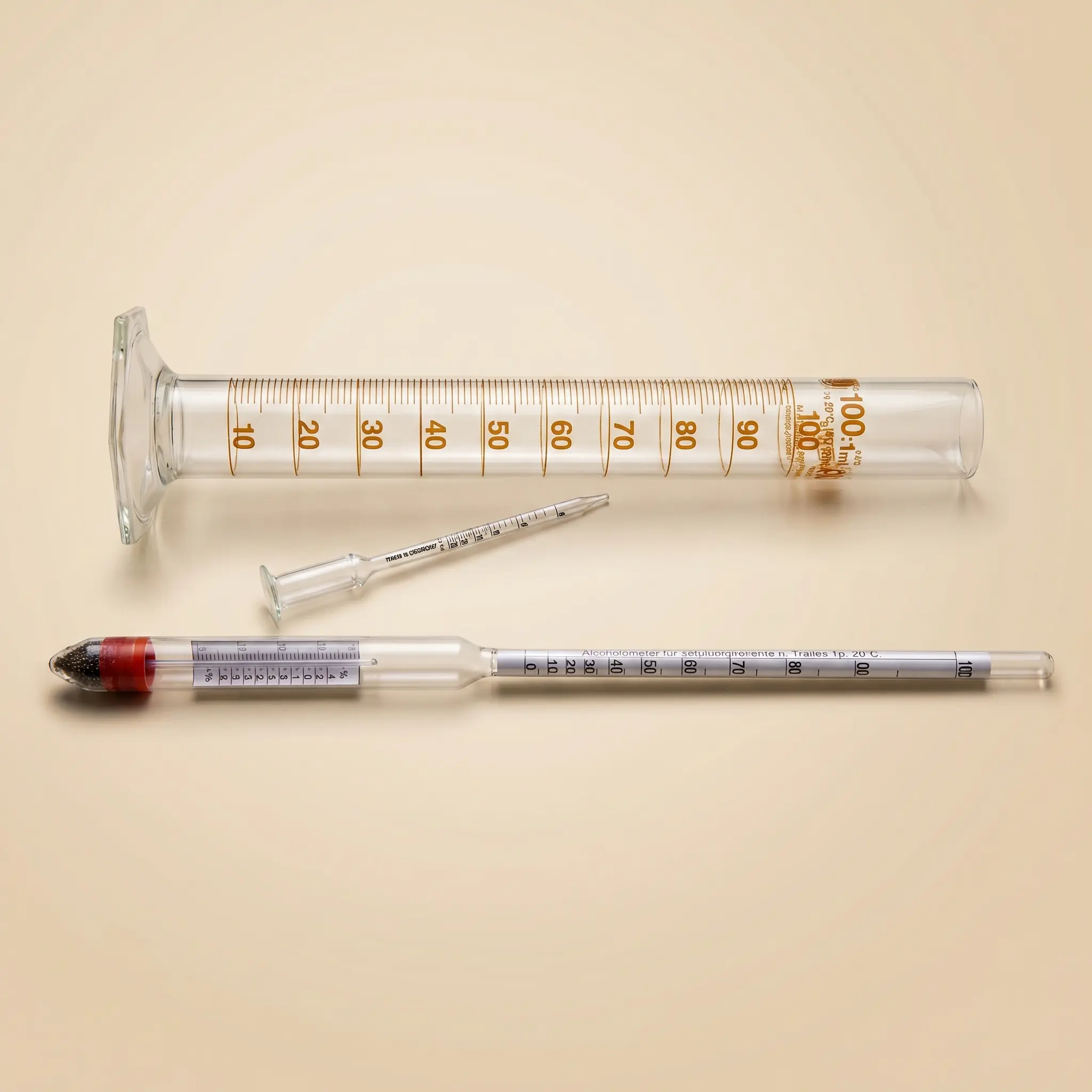
A thermometer can also be helpful when working with vessels such as the beaker and the measuring cylinder. It shows whether a liquid is still warm, whether a batch is reaching room temperature or whether a working step is being carried out reproducibly. With small quantities of liquid, temperature changes can occur more quickly, which makes deliberate observation particularly practical.
Cleaning and handling
After use, the thermometer should be cleaned if it has come into contact with liquids or vapours. The cleaning method depends on the medium used and the material of the instrument. In many simple cases, careful wiping or rinsing is sufficient; for problematic liquids the cleaning must be adapted accordingly. Avoid heavy mechanical loads, impacts and tilting, especially when the thermometer is used in glass vessels or stoppers.
A clean, dry place where the thermometer cannot fall down or be damaged by other tools is suitable for storage. If it is stored together with accessories, the measuring tip should remain protected. Confusion should also be avoided if several thermometers are kept for different tasks.
Avoiding mistakes
A common mistake is to insert the thermometer into the set-up but fail to check the measuring point. The result may then be that not the liquid itself, but a wall area, a vapour zone or an unfavourable edge region is being observed. Reading too late can also distort values if the temperature has already changed again. It is better to plan the measurement deliberately as part of the workflow.
With hot liquids, glass apparatus and chemical solutions, careful working is also necessary. The thermometer is a measuring instrument, not a protective device. It indicates a temperature but does not prevent burns, glass breakage or incorrect use. Always check whether the vessel, medium, temperature range and fixing are matched to one another.
Matching products in the shop
The thermometer pairs sensibly with the drilled silicone stopper when it is to be guided through an opening. For work with liquids, the beaker, measuring cylinder and wash bottle, 500 ml are also suitable. In the context of vinegar production, the Schmickl Vinegar Reactor, Zeolite Spezial, mother of vinegar and the Acetic Acid Analysis Set are relevant products when temperature monitoring, process management and acid control are considered together.
For small quantities of liquid or for samples, the glass Pasteur pipette, the plastic Pasteur pipette and the volumetric pipette can be sensible additions. The thermometer remains a basic measuring instrument throughout: it makes temperature visible and helps to document workflows more deliberately.
Further information
A general technical introduction can be found in the neutral Wikipedia article on the thermometer. For practical use in the shop context, what matters most is to position the thermometer appropriately for the set-up, to read it carefully and not to assess the measured values in isolation from the respective working step.
Technical details
| Weight | 0,112 kg |
|---|---|
| Dimensions | 30,5 × 1 × 1 cm |


Reviews
There are no reviews yet.